Greetings all! I pray that God is blessing you as you serve Him! Today’s post is a little different as I want to talk about an aspect of Japanese culture that I would like to deem as the, “ganbare lifestyle” or mentality. Ganbare or 頑張れ in Japanese roughly translates to, “do your best!”
As a foreigner in a foreign Asian country, I think that this mentality permeates the culture in a much deeper way than I could have ever imagined. From workplace culture, to your attitude towards school, towards everything you do in your life in Japan, you are expected to, “Do you best” no matter what the cost to you may be. Although the concept of, “doing your best in everything” exists in Western culture as well, (and I firmly believe that especially as Christians we should always strive to do our best and work with excellence and all of our hearts as unto to the Lord and not unto men, Colossians 3:23-24) I’ve seen this expression taken to new heights in Asian society, including Japan.
For example:
For public workers and salary men, this could mean working extra over time, exceeding 80 hours a week without taking breaks. This can lead to Karoshi, Death and Injury from Overwork, and work-related suicides, which is a huge social problem in Japan that affects thousands of people every year (https://www.mhlw.go.jp/content/11200000/001065344.pdf)
For students, this could mean skipping meals (because if you eat then you would be too sleepy to study) and then if that doesn’t work then you should be taking cold showers at all hours of the night just in order to stay awake to complete your homework for the next day (which has been encouraged to me by my teachers on several occasions).
I’ve seen this first hand as people walk around Osaka looking stressed, anxious and frankly, overworked. Many people at school are pushed to their mental and physical limits and losing weight and sleep are not indicative as signs of a problem, but are rather celebrated and praised, being related to being a more diligent, harder working and less lazy person. Often times, the advice/solution to any problem in Japan that I’ve heard straight from Japanese people is to, “just work harder” or “just do more.” Failure is not an option as it is connected to shame and guilt, which is extremely avoided and considered dishonorable. Despite the workload being so intense and it often seems as if there are not enough hours in the day to complete everything, if you can’t produce the results necessary, you are not, “doing enough.”
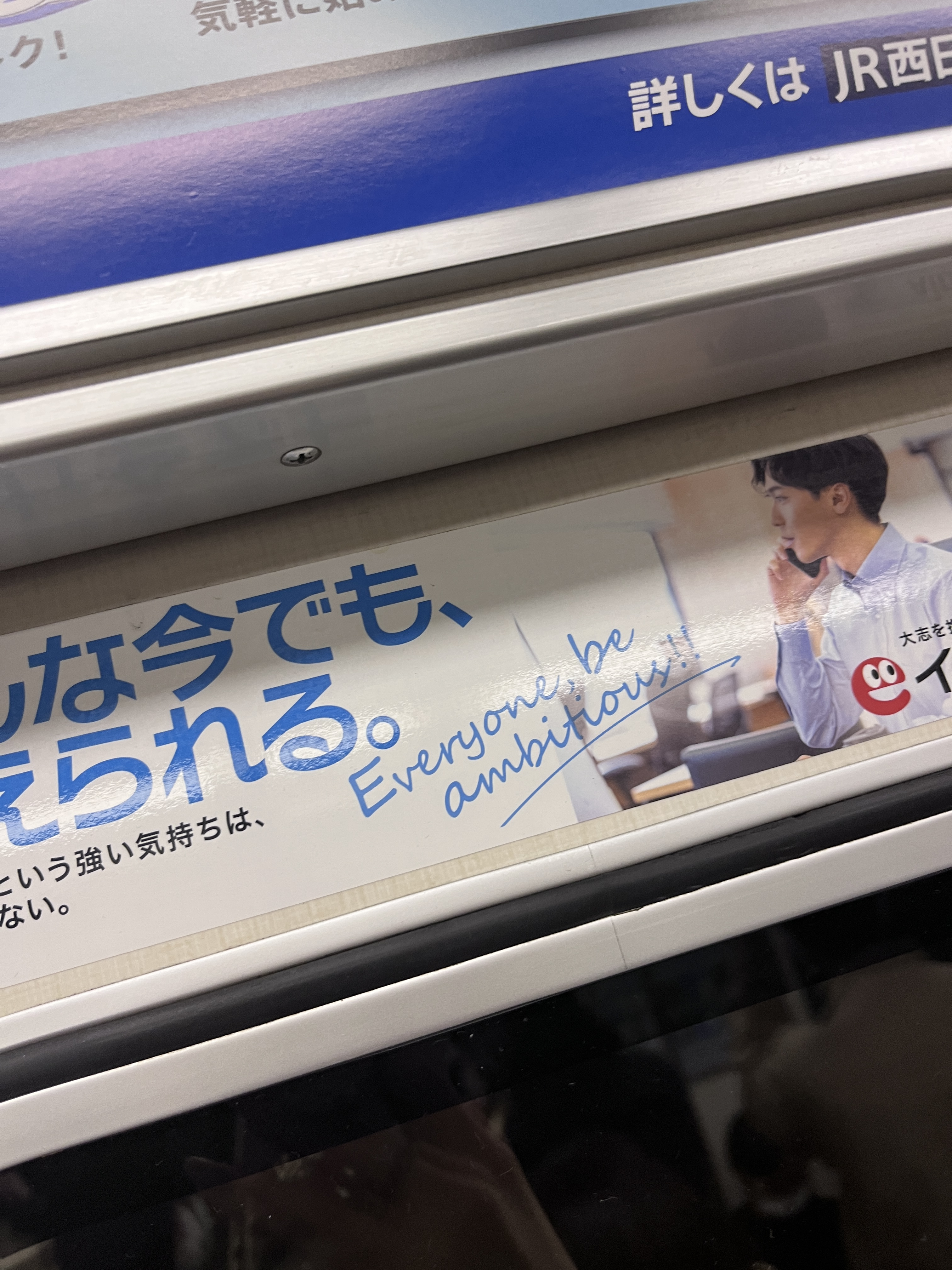
This mentality is being propagated through bosses and teachers but also through media and advertising as well. If you don’t look like you’re working to the point of exhaustion, you may be judged or deemed someone who isn’t as “serious” about their goals. The immense pressure felt here is different from Western culture in the sense that people here are quicker to judge others by their performance as well as physical appearance. In Western culture, this pressure also exists but not encouraged to the extent of physical harm or mental unwellness. It would appear that as long as you are coming into work or school, your mental wellbeing and physical health are second to the performance that you can output. Such a luxury of being cared for physically or mentally or even “wellness checks” or interventions are scarce or non-existent. Everyone appears to ignore this issue or at least have learned to live with it as everyone works at the same rhythm to the, “just do you best” song that continually resounds in the streets.
I find this aspect of Japanese culture to be challenging, as I see many people suffering in silence in order to just live their daily lives and exist in their society. I believe that many people lack hope and that they often put work and other things before themselves, very often to a fault or their own detriment. Although the concepts of putting others first (Philippians 2:3-11) and doing your best in all circumstances (2 Timothy 2:15) are Christian principles and very good to abide by, and we should, these principles are being implemented in Japan with a motive of duty instead; without Jesus being at the center. God is concerned with our hearts and our motives and offers us help and strength in all circumstances (Isaiah 41:10). I feel for Japanese people as they don’t have the knowledge of God, so they work themselves into mental and physical exhaustion with no help, no comfort, and no peace. I pray that Japanese would come to know Christ and realize that they are accepted in Him if they believe in Him and that they will be rewarded as they serve Him.
-Romans 5:1 ESV-
“Therefore, since we have been justified by faith, we have peace with God through our Lord Jesus Christ.”
Too much of even a good thing can be bad if taken to the extreme (Proverbs 25:16). I pray that the Japanese would find their peace and help in Christ our Lord Jesus and Heaven alone. May God bless Japan and the Japanese with the knowledge of Him.
Thank you for reading!
 Lifted Vision Ministry
5 responses to “The “Ganbare Lifestyle” of Work Culture in Japan”
That is sad! 🥺
LikeLiked by 1 person
I felt the same weight of that feeling too! 😢Let’s continue to pray for Japan!
LikeLiked by 1 person
Loved reading more about this. From an outside POV, you can see that Japanese people are dedicated and super hard-working. But “ganbare” isn’t the happy, positive encouragement, but more so, “work hard, keep going, because you have to.” There’s striving and a searching for identity and acceptance, a fear of rejection. Praying with you, Aly, for rest and peace over Japanese people. And I pray over you that you do not conform to the patterns around you but have a renewed mind in Christ!
LikeLiked by 1 person
Thank you so much for reading and your continued love, prayer support and encouragement! God bless you too!
LikeLike
Amen! Thanks Gina!! ❤
LikeLike